
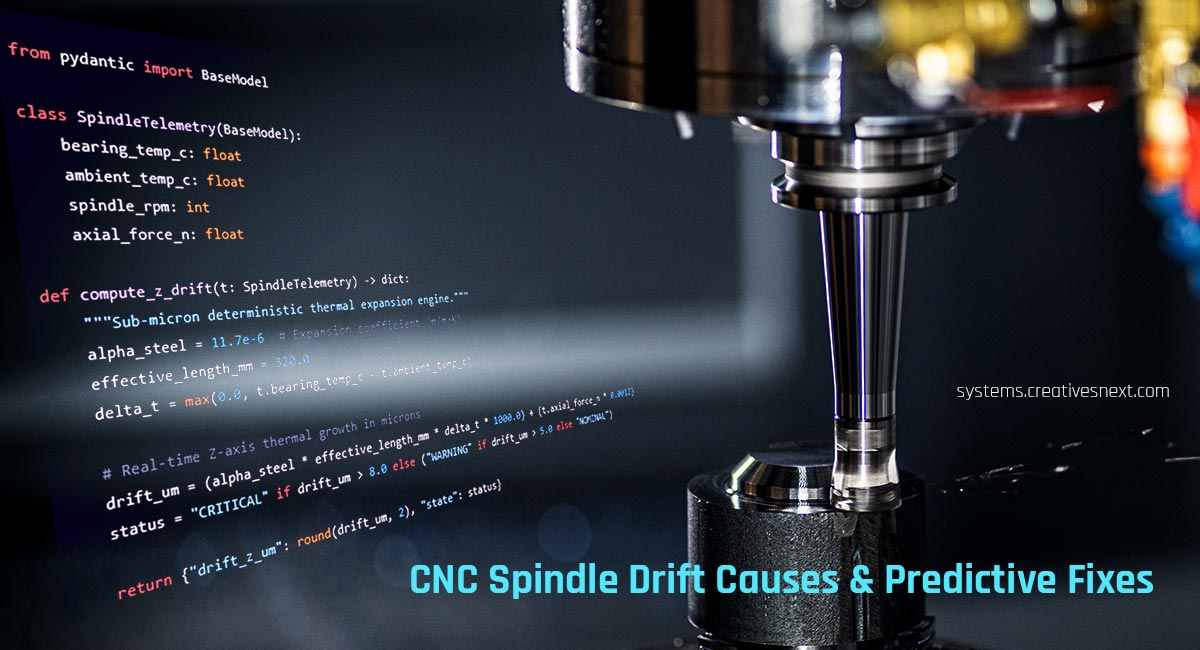
Introduction: The Invisible Cost of Thermal Expansion in Precision Machining
In modern aerospace manufacturing, medical implant turning, and die-mold finishing passes, dimensional tolerances frequently hover in the sub-10µm range. While static mechanical leveling, granite bed dampening, and laser interferometry resolve geometric misalignment during machine setup, continuous high-speed spindle operations introduce an aggressive, dynamic variable: thermo-mechanical drift.
As spindle rotors accelerate between 10,000 and 30,000 RPM, continuous friction inside angular contact bearings, stator eddy currents, and fluctuating shop-floor ambient conditions generate localized heat gradients. Because mechanical structures expand along the path of least constraint, thermal growth primarily manifests along the spindle axial centerline—the Z-axis.
When unmonitored and uncompensated, an axial displacement of merely 6 to 8 microns pushes the tool tip deeper into the workpiece than commanded by the CNC controller. On expensive titanium (Ti-6Al-4V) or Inconel 718 aero-structures, this microscopic thermal migration triggers instantaneous tolerance breaches, turning a five-figure workpiece into unrecoverable scrap.
The High-Precision Operational Paradox
While CNC machine tool beds are stabilized with polymer concrete or cast iron, the rotating spindle cartridge acts as a thermodynamic heat pump. Ambient coolant flooding mitigates outer tool temperatures but creates localized structural temperature deltas that exacerbate spindle bearing preload variations.
Physics & Mechanics: Understanding Axial Z-Axis Growth
1. The Thermodynamic Equilibrium Lag
A precision spindle tool assembly never reaches instantaneous thermal equilibrium. When a duty cycle transitions from high-feed roughing to delicate finishing cuts, the heat dissipation curve lags behind the rotational RPM drop. The spindle assembly retains heat, creating a hysteresis loop where the actual Z-axis position does not correlate linearly with ambient shop sensors.
Where ΔL represents axial drift, α is the linear coefficient of thermal expansion, L_effective is bearing cartridge distance, and K_load accounts for mechanical deflection under cutting force.
2. Bearing Preload Non-Linearity
High-precision spindle cartridges rely on matched hybrid ceramic or steel angular contact bearing sets. As thermal growth occurs, the outer housing typically warms at a slower rate than the rotating inner rings. This disparity increases the internal bearing preload, exponentially generating additional friction heat—a dangerous positive feedback loop known as thermal runaway.
The Architecture: Deterministic Physics vs. Black-Box AI
Traditional industrial IoT systems attempt to solve this challenge using pure empirical "black-box" machine learning. They stream thousands of raw vibration and thermocouple data points to an external cloud server, run deep neural networks, and return an estimated compensation figure. In factory shop-floor realities, this approach fails due to two fatal flaws: cloud communication latency (150–500ms) and complete loss of predictive inference when the plant network is air-gapped.
The Next Gen AI Real-Time Spindle Drift Engine solves this via a hybrid edge architecture:
- Deterministic Physics Layer (Sub-Millisecond Execution): A calibrated empirical thermal-mechanical expansion engine executes locally on edge IPCs, calculating micron-level axial displacement in sub-second cycles without network overhead.
- Calibrated Tolerance Bounds:
- NOMINAL (Drift ≤ 5.0 µm): Normal continuous operation. No operator intervention required.
- WARNING (5.0 µm < Drift ≤ 8.0 µm): Automated alert generated. Dynamic spindle tool wear offset (G43/G44 compensation) recommended before executing finishing passes.
- CRITICAL (Drift > 8.0 µm): Imminent bearing runout or critical part scrap. Automated emergency feed-hold trigger recommended.
- Local AI Root-Cause Reasoning (BYOK / Air-Gapped): When warning thresholds are tripped, local LLM microservices (via Ollama or vLLM running on local hardware accelerators) inspect vibration harmonics and duty profiles to explain why the drift occurred (e.g., coolant bypass failure vs. lubrication breakdown).
Universal 5-Stream Fieldbus Ingestion Matrix
A machine shop rarely operates CNCs from a single manufacturer. A typical facility houses German 5-axis mills alongside Asian turning centers and North American vertical machining centers. This platform incorporates an edge adapter layer normalizing five distinct industrial fieldbus protocols into a single unified telemetry schema:
| Geographic Standard | Protocol / Standard | Target CNC Fleet & Controllers | Ingestion Frequency |
|---|---|---|---|
| Europe & Germany | OPC UA (IEC 62541) | Siemens Sinumerik (828D / 840D sl), Beckhoff TwinCAT, Heidenhain TNC | 50 Hz (20ms cycle) |
| Japan & Asia-Pacific | Modbus TCP / RTU | Fanuc 0i / 30i / 31i, Mitsubishi M80, Delta, Yaskawa, Auxiliary Transducers | 20 Hz (50ms cycle) |
| North America & Global | MTConnect (XML / REST) | Haas VF / UMC Series, Mazak SmoothX, DMG Mori CELOS | 10 Hz (100ms cycle) |
| China National Standard | NC-Link (GB/T 41870-2022) | Huazhong CNC (HNC-8 / HNC-9), GSK CNC, Syntec, Weihong / NcStudio | 25 Hz (40ms cycle) |
| Legacy Retrofit | Bolt-On MQTT Sensor Puck | Non-networked manual mills, older bridgeport-style machines, external magnetics | 100 Hz Async (QoS 1) |
Air-Gapped Deployment: Zero Cloud Leakage & Cryptographic Node-Locking
Aerospace and defense contractors subject to ITAR, ISO 27001, or NIST SP 800-171 cannot permit machine tool feed-rates, spindle loads, or workpiece geometry metadata to escape the physical shop-floor firewall.
This engine runs 100% offline:
- Air-Gapped Local Inference: Local AI reasoning agents bind directly to quantized local models (Llama-3, Mistral, or DeepSeek via Ollama / vLLM) on shop-floor edge Industrial PCs (IPCs) or on-premise workstations. Zero data packets exit the plant.
- Asymmetric Ed25519 Hardware Binding: Software integrity and licensing are enforced via cryptographic SHA-256 host hardware digest generation (binding to Motherboard DMI UUID, OS Machine ID, and physical NIC MAC addresses). Licensing contracts are verified using public-key elliptic curve signatures (Ed25519) without requiring internet "phone-home" handshakes.
Technical FAQ: Machine Tool Builder & Plant Lead Inquiries
Q1: Can this system write dynamic offset compensations directly to the CNC controller?
Yes. In read-only passive mode, the engine alerts operators via browser dashboards or local MQTT alerts. In active closed-loop mode, the microservice interfaces with controller macro variables (such as Fanuc Custom Macro B #500 series or Siemens R-Parameters R100+) via fieldbus write commands, allowing automated Z-axis tool offset compensation between tool change cycles.
Q2: How does the deterministic physics model calibrate to our specific spindle brand?
The engine incorporates a baseline calibration matrix configured via an offline .env parameter file. Engineers define the spindle bearing layout (tandem vs. back-to-back), spindle housing material (cast iron vs. steel alloy), and maximum RPM rating. The physics engine automatically dynamically scales its thermal expansion coefficients based on these mechanical boundary constraints.
Q3: What are the bare-metal hardware and operating system requirements?
The runtime is verified across both modern 64-bit Windows (Windows 10, 11, Windows Server) and edge-native Linux environments (Ubuntu 22.04/24.04 LTS, Debian, RedHat, Yocto, or Windows Subsystem for Linux WSL2). It requires a minimum of a quad-core 64-bit x86/ARM IPC with 4GB RAM and Python 3.10/3.11 with standard C-runtime dependencies.
Q4: How does this compare economically with OEM proprietary options?
Legacy machine tool builders frequently package thermal compensation as a locked factory option costing between $15,000 and $45,000 per machine tool, often chained to proprietary sensor grids and annual software subscriptions. The Next Gen AI architecture provides an open, hardware-agnostic alternative with perpetual, royalty-free node-locked licensing at a flat $999 USD per machine—delivering immediate ROI on the very first avoided scrap cycle.
Deploy the Spindle Drift Predictive Engine
Eliminate thermal scrap and unpredicted spindle bearing failure before your next high-value aerospace cycle. Test the telemetry ingestion on your bare-metal factory IPC today.